Choose Corflute for economical temporary signs, PVC foam board for smooth close-view indoor displays, and ACM when rigidity, flatness and a longer-term professional finish matter.
The cheapest sheet is not always the cheapest finished sign. A board that flexes, shows its fluted edge or is unsuitable for the exposure may need early replacement. Start with where it will be installed, how long it needs to stay presentable, how it will be fixed and how closely customers will see it.
The quick comparison
| Material | Best suited to | Typical position | Relative rigidity | Relative cost |
|---|---|---|---|---|
| Corflute | Events, property signs, site notices, short promotions | Indoor or short-term outdoor | Light and flexible | Lowest |
| PVC foam board | Retail displays, menus, exhibitions, indoor wayfinding | Mainly indoor; sheltered outdoor only when the grade suits | Smoother and more rigid than Corflute | Mid-range |
| ACM | Shopfront panels, directories, hoarding, longer-term signs | Indoor and outdoor | Highest of the three | Highest |
These are relative comparisons, not lifespan guarantees. Sheet grade, panel size, print or vinyl system, protective finish, fixing method, exposure and maintenance all affect performance.
Corflute: practical for temporary and high-volume signs
Corflute is a twin-wall polypropylene sheet. Its fluted construction keeps it light while giving enough stiffness for many temporary applications. It is easy to carry, cut and replace, which is why it is widely used for real estate signs, event directions, construction notices, campaign boards and A-frame inserts.
Its advantage is value. If a campaign needs many boards across several locations, or the message will change regularly, Corflute keeps material and handling costs sensible. UV-stabilised grades are available, but the exact grade, support and fixing still matter outdoors.
The trade-off is presentation and rigidity. Flutes and open edges may be visible at close range, while large unsupported sheets can flex or bow. Wind can put substantial stress on a light panel and its fixings. Treat it as a temporary or replaceable outdoor solution unless the project is specifically engineered otherwise.
PVC foam board: smooth, lightweight and display-friendly
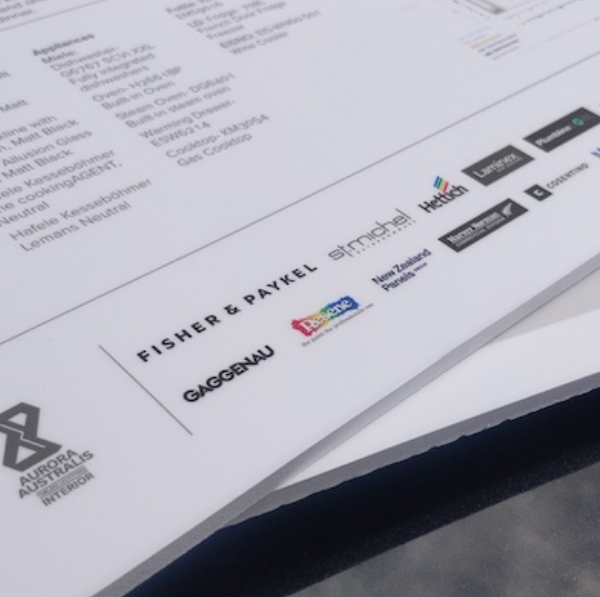
PVC foam board, often known by product names such as Palight, has a smooth and consistent surface that suits direct printing, applied graphics and close-view presentation. It looks more solid than fluted polypropylene while remaining lightweight and easy to handle.
Typical uses include point-of-sale displays, exhibition graphics, menu boards, reception signs, indoor directional signs and promotional wall panels. Its smooth face is useful where customers will see the graphic at close range.
The important limitation is that “PVC foam board” covers different grades. Manufacturers separate print-focused products from UV-protected exterior grades. A standard print-grade sheet should not automatically be treated as a permanent outdoor panel. Heat, unsupported panel size, mounting position and dark graphics can also affect movement and flatness.
View Foam Board Sign / Palight →
ACM: rigid and suited to longer-term signage
ACM uses two thin aluminium cover sheets bonded to a core. That construction produces a panel that is relatively light for its rigidity and stays flatter than Corflute or standard foam PVC. It is widely used for indoor and outdoor signage, direct printing, shopfitting and exhibition work.
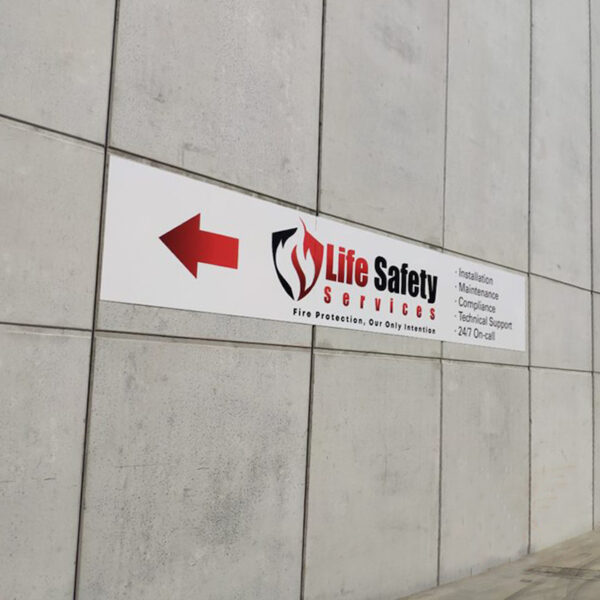
Common applications include shopfront panels, business identification signs, building directories, construction hoarding, reception branding and longer-term wayfinding. Of these three materials, ACM is usually the strongest candidate where the panel needs a clean, solid appearance or will remain outdoors longer.
The aluminium faces do not make every finished sign maintenance-free or suitable for every building application. Graphic durability still depends on the print or applied film, laminate where used, edge treatment, cleaning, orientation and UV exposure. Panel and core specifications also vary.
Signage-grade ACM must not be assumed to be compliant exterior cladding or a fire-rated building system. Facades, structural fixings and regulated building work need the correct specified system and, where applicable, professional or council review.
Which board should your business choose?
For short campaigns, temporary information, easy handling and larger quantities.
For smooth indoor displays and a refined close-view surface without a metal-faced panel.
For rigid exterior business signs, directories and longer-term professional presentation.
Also consider wind exposure, coastal conditions, direct afternoon sun and whether the sign is fixed to a wall, frame, fence or freestanding structure. The same material behaves differently in a sheltered retail interior, on a sunny north-facing wall or at an exposed coastal site.
Material choice is only one part of a reliable sign. Panel size, artwork, print finish, edge clearance and fixings should be assessed together. Sign rules can also vary by sign type and location, so some permanent or building-mounted signs need a separate compliance check.
What to send for an accurate recommendation
Include the finished size, quantity, indoor or outdoor location, expected period of use, fixing method and a clear photo of the site.
Common questions
Is ACM the same as solid aluminium?
No. ACM is a composite panel with thin aluminium faces bonded to a core. It provides useful rigidity at a lower weight, but its specification and use differ from solid aluminium sheet.
Can PVC foam board be used outside?
Some exterior grades can, but standard print-grade foam PVC should not automatically be specified for long-term unsheltered use. Confirm the sheet grade, exposure, panel size and fixing method.
Does Corflute handle rain?
The polypropylene sheet is moisture resistant, but outdoor success still depends on the exact grade, wind exposure, support, fixings and how long the sign needs to remain presentable.
Technical references
Material descriptions were checked against official information from 3A Composites DIBOND, Palram PALIGHT and Corflute manufacturer data. Site-specific rules should be checked against current Auckland and New Zealand requirements.